Meaningful Marriage and Commitment for Adults
There comes a point when the marriage bookshelf changes. The books for newlyweds explain how commitment works; the books for adults ask what it costs. This is that shelf - the meaningful marriage and commitment books for adults, the ones that take the conversation beyond the seven principles and into the harder territory of desire in long commitment, repair after deep wounding, and the ordinary decades that most books skip.
Why Adults Need a Deeper Shelf
It is worth asking the question directly, because it is easy to assume that marriage books are for the beginning of a marriage. The honest answer is that the hardest work of commitment happens in the long middle - the decades after the courtship, when the novelty is gone and the commitment must be practiced daily, without applause. That is adult work, and the deepest books are written for it.
The books on this shelf are for that work. They are not primers; they do not explain the basics. They ask the questions that the primers avoid: how do you keep desire alive inside security? What does repair require after a deep wound? What does commitment mean in the ordinary years when nothing dramatic is happening? They are honest books, and the honesty is the point.
The Long Middle
The courtship stories end at the wedding; the adult shelf begins there. The book that names the territory best is The Course of Love.
The Course of Love by Alain de Botton
de Botton’s novel-in-essays is perhaps the most honest book ever written about the ordinary difficulties of staying committed. It follows a couple from first meeting through marriage, children, infidelity and the quiet daily grind, and its central claim is that the romantic ideal of effortless love is the enemy of real love. Real commitment, de Botton argues, is the daily decision to keep choosing a person you have learned to see clearly - a person who annoys you, who fails you, who is not the fantasy you married.
The book is essential reading for anyone in the long middle, because it tells the truth that the courtship books cannot: that the ordinary years are the real marriage, and that the work of those years - the tolerance, the repair, the decision to stay - is the love.
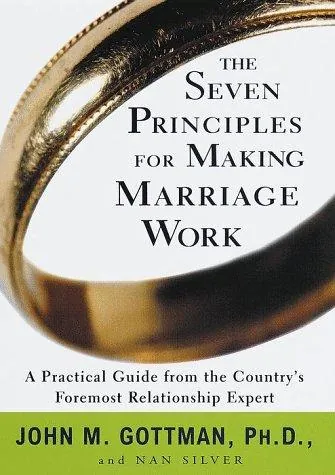
The Seven Principles for Making Marriage Work by John Gottman
Even the adult shelf begins with the research, because the research is where the honest work starts. Gottman’s findings - that lasting marriage is predicted less by the absence of conflict than by the quality of repair - are the foundation of the adult conversation. The couples who last are not the ones who never fight; they are the ones who turn toward each other after the fight, who repair the rupture, who choose each other again in the aftermath. The research is the map the deeper books travel.
Desire Inside Security
The question the adult shelf asks that no primer asks is the question of desire: how do you keep wanting the person you have committed to, year after year? The essential book is Esther Perel’s.
Mating in Captivity by Esther Perel
Perel’s book is the most important contribution to the adult marriage shelf in decades, because it names the problem the self-help books deny: that security and desire pull in opposite directions. The couples who keep desire alive, Perel found, are not the ones who merge completely; they are the ones who preserve some mystery, some separateness, some space for the partner to be a stranger again. Desire needs distance; intimacy needs closeness; and the adult work is to hold both.
The book is provocative, and it should be. It challenges the assumption that a good marriage is a completely open book, and it offers a more demanding vision: a marriage of two whole people who choose each other across the space between them. For couples in the long middle, it is essential reading.
The State of Affairs by Esther Perel
Perel’s second book asks the hardest question of all: what does infidelity mean, and can a relationship survive it? Her answer is not comfortable. She treats affairs as events with meaning rather than simply as betrayals, and she argues that the aftermath - however painful - can sometimes lead to a more honest relationship than the one that existed before. The book is for couples facing the worst test of commitment, and it treats them with a compassion that the moralizing shelf lacks.
The book is not an endorsement of infidelity; it is an honest examination of it. For couples in crisis, it offers something the other books do not: the possibility of understanding, and the hope of repair.
The Books That Tell the Truth About the Ordinary
It is worth dwelling on the quality that unites the adult shelf, because it is the quality the primers lack: honesty about the ordinary. The Course of Love tells the truth about the boring Tuesday and the petty irritation; Mating in Captivity tells the truth about the desire that fades and must be tended; The State of Affairs tells the truth about the betrayal that happens in real marriages; Hold Me Tight tells the truth about the pattern of pursuit and withdrawal that erodes love without anyone noticing. The adult shelf is not for comfort; it is for clarity - and the clarity is the gift.
The reader who wants the comfort version of marriage should stay on the primer shelf; the reader who wants the marriage itself should come here. These books will not make a couple feel better about their marriage on the first reading; they will make them see it more clearly, and the seeing is the beginning of the adult work. The honesty is the point, and the couple that can bear it is the couple the shelf is for.
Repair After Deep Wounding
The adult shelf is honest about the deepest wounds - the betrayals, the failures, the long silences - and the books that address them are the most demanding on the shelf.
Hold Me Tight by Sue Johnson
Johnson’s book is grounded in attachment science, and it addresses the deepest wounds of marriage: the moments when one partner’s bid for connection goes unanswered so often that the other stops bidding. Her account of the demon dialogue - the pursue-withdraw cycle that erodes so many marriages - explains the pattern beneath the fights, and her seven conversations offer the repair. For couples who have been wounded by the pattern, the book is the way back.
The Course of Love and the Ordinary Repair
It is worth returning to de Botton here, because his book is the most honest account of ordinary repair on the shelf. The repair that matters, he shows, is not the dramatic reconciliation; it is the small daily turning - the apology offered, the irritation forgiven, the decision to stay through the boring Tuesday. The adult work is mostly this: the unglamorous, repeated repair of the ordinary rupture. The books that honor that work are the ones that tell the truth about it.
The Discipline of the Long View
It is worth naming the quality that the adult shelf demands of its readers, because it is the quality the books themselves are about: the long view. The research books take decades of observation to produce a finding; the novels take hundreds of pages to show a marriage; the harder books ask a couple to consider their commitment across a lifetime. The adult shelf is training in thinking about marriage on the scale on which marriage actually happens - not in weeks or seasons but in decades, with the ordinary middle years as the real territory.
The long view changes what a couple reads and how they read it. A primer asks what to do this week; the adult shelf asks what a marriage looks like from the far end, looking back. The couples who can hold that view - who can read Anna Karenina and see not a story but a warning they have time to heed, who can read Perel and see not provocation but the map of their own long middle - are the couples for whom the shelf does its deepest work. The long view is the discipline, and the books are the training.
The Hard Question of Staying
The adult shelf ends where the primers begin: with the question of whether to stay. The meaningful books do not assume the answer; they examine it.
Anna Karenina by Leo Tolstoy
Tolstoy’s novel remains the deepest account of the choice to stay or leave. Anna leaves her marriage for passion and finds that passion without commitment becomes its own prison; Levin stays and works at his marriage the way he works at his land, and finds the peace Anna cannot reach. The novel does not romanticize either choice; it shows the cost of both. For adults facing the question, it is the essential book.
Pride and Prejudice by Jane Austen
Austen’s novel is the counterpoint: the account of commitment chosen well. Elizabeth and Darcy build their commitment on the painful revision of their judgments - each admits they were wrong, each chooses the other having seen clearly. The book’s lesson is that the choice to stay is only meaningful when it is a choice - made by people who have seen each other whole and decided anyway.
How to Read These Books as Adults
The adult shelf demands a different reading practice. Three things make the difference.
First, read together, slowly. These are not books to skim; they are books to live with, one chapter at a time, over weeks. The slow reading is part of the work.
Second, let the book surface what needs surfacing. The deepest books will bring up real conflicts - the desire that has faded, the wound that was never repaired, the question of whether to stay. The surfacing is the work, and the practice is to meet it honestly rather than to close the book.
Third, practice one thing at a time. Choose a single behavior - a daily turning toward, a repair ritual, a conversation from Johnson’s book - and commit to it for thirty days. Depth beats breadth, and the practice is the point.
A Note on the Harder Books
It is worth being honest about the demands of the harder books on this shelf, because they are not for every couple at every moment. Mating in Captivity and The State of Affairs ask questions that can be destabilizing: they challenge the assumption that a good marriage is a completely open book, and they treat infidelity with a compassion that can feel threatening to couples who prefer certainty. The Course of Love tells truths about the ordinary that some readers find deflating before they find liberating. These books are best read when the couple is stable enough to be challenged - not in the middle of a crisis, when the primer shelf and the repair books are the right tools, but in the calmer middle, when the questions can be examined rather than survived.
None of this is a warning against the books; it is a guide to reading them well. The harder shelf is the deepest shelf, and the couple that can bear its honesty is the couple it will help most - but the bearing is a condition, not a given. Read them slowly, together, and put them down when the questions are too live. The shelf will still be here when the couple is ready.
The Adult Reading Path
There is no required order, but a useful sequence exists. Start with the research - The Seven Principles - to ground the conversation. Add The Course of Love for the honest account of the long middle. Read Perel when the questions of desire and infidelity are live, and Johnson when the wounds are deep. End with the novels - Anna Karenina, Pride and Prejudice - for the depth of the choice itself.
For couples who want the conversation to continue into the family it builds, our guide to parents and children for adults carries the shelf into the next generation, and our guide to family values for adults deepens the family conversation. For readers who want to keep the reading clean, our guide to books without profanity gathers more titles.
Conclusion
The meaningful marriage and commitment books for adults ask the questions the primers avoid: how to keep desire alive inside security, what repair requires after deep wounding, and what commitment means in the ordinary decades of a shared life. They are honest books, and the honesty is the point.
Read them together, slowly, one chapter at a time. Let them surface what needs surfacing, practice one thing for thirty days, and stay with the work. The research is the map; the novels are the mirror; and the marriage you build while reading is the point.
Frequently Asked Questions
What is a meaningful marriage book for adults?
Why do adults need a deeper marriage shelf?
What is the long middle of a marriage?
Can desire survive long-term commitment?
What is the hardest question in marriage?
How should adults read these books?
Featured Recommendations

Raining Book Editorial Team
The Raining Book editorial team curates the best book recommendations and reading guides for every type of reader.