The Best Closed-Setting Thrillers: Books With No Escape
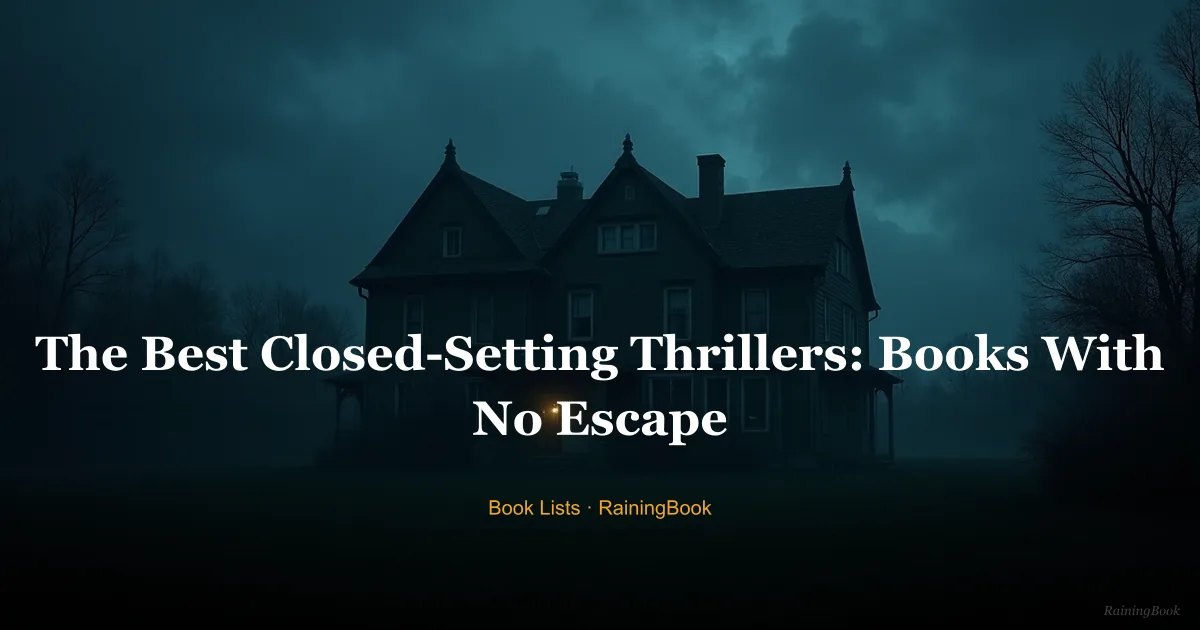
The door clicks. The bolt slides home. You’re in. There is no way out.
The closed-setting thriller is a pressure cooker. It strips away the “escape hatch” we take for granted. No cell signal. No back door. Just you, the walls, and the slow crawl of dread. In these stories, the setting is not a backdrop. It is the primary antagonist. It is a predator waiting for your air to thin and your sanity to snap.
We watch because we want to know: who are we when the world shrinks to a single room? When the exits vanish, the social masks follow. It is primal. It is visceral. The air turns rancid, and the walls start to breathe. Welcome to the cage.
Key Takeaways
- Closed-setting thrillers use the environment as an active antagonist.
- The best examples blend physical confinement with psychological unraveling.
- Recent releases explore everything from luxury bunkers to cryogenic spaceships.
- The genre continues to evolve, with 2026 delivering some of the most inventive entries yet.
Download our slide deck on closed-setting thriller tropes for a visual overview of the themes and techniques discussed below.
The Psychological Trap: Why We Can’t Look Away
The appeal of the locked room goes deeper than simple suspense. Psychologically, the closed setting triggers our most fundamental fears: loss of control, helplessness, and the knowledge that no one is coming to help. When the world collapses to a few square feet, every decision becomes a matter of life and death.
But the genre is not without its critics. Some argue that the premise can feel contrived - characters often make baffling choices to remain trapped. Yet when executed with precision, the claustrophobic setup forces readers to confront their own vulnerabilities. The best authors turn the space into a character, breathing life into the walls themselves.
To understand the full power of confinement, consider the specific phobias each book targets. Claustrophobia - the fear of enclosed spaces - is the obvious trigger in a buried shipping container or a stalled train car. But agoraphobia also surfaces, especially in novels like Cold Eternity where the endless void of space makes any enclosed capsule feel both sanctuary and prison. Such Quiet Girls weaponizes a different fear: suffocation, the slow depletion of breathable air that turns every inhale into a countdown. In The Crash, the protagonist’s broken body adds a layer of physical helplessness - she cannot even crawl to a door that might exist. These books don’t just lock characters in a room; they exploit the specific dread that arises when movement, air, and hope are all rationed. The tradition of treating the setting as character in American literature finds its darkest expression here, where the landscape becomes a predator. For fans of the macabre, this evolution connects directly to the gothic horror and confinement that has haunted fiction for centuries. And as the genre pushes boundaries, we’re seeing a rise in genre-bending thrillers with experimental settings that refuse to stay in one box.
For a deeper dive into contemporary literary trends, check out our mind map on the contemporary literary landscape, which places these thrillers within the larger cultural moment.
The Billionaire’s Bunker: Luxury as a Tomb
Wealth buys many things. Sometimes, it just buys a more expensive coffin.
S.A. Bodeen’s legacy work, The Compound, remains the gold standard for paternal horror. Billionaire Rex Yanakakis herds his family into an ultra-luxury fallout shelter to “save” them from a nuclear apocalypse. But the war is a lie. The shelter is a lab. Rex is the god of this concrete hole, forcing his family to drink his wife Clea’s breast milk via an electric pump - a chilling display of his total control. The real rot? The “Supplements.” These are extra children born in the dark, raised for one reason: to be butchered as meat when the rations fail.
Aisling Rawle’s recent reimagining of The Compound moves the horror from forced confinement to voluntary entrapment. Lily, a beautiful, bored influencer, enters a high-surveillance desert facility for a reality show. She wants champagne and lipstick. Instead, she finds a high-stakes hellscape where contestants compete for basic survival - including a “front door.” It is a blistering takedown of reality TV in a capitalist world. The “winner” gets the ultimate prize: total, hollow isolation.
Where Bodeen’s novel indicts the patriarchal ideal of the all-powerful father who controls every breath, Rawle’s version critiques the seductive lure of fame and the voluntary surrender of freedom for the sake of views. In Bodeen, the luxury bunker is a cage built by one man’s delusion of protection. In Rawle, the luxury compound is a cage participants sign up for, convinced they will be the one to beat the system. This shift from patriarchal control to capitalist critique mirrors a broader cultural anxiety: we no longer fear being locked in by a tyrant as much as we fear volunteering for our own confinement in exchange for fifteen minutes of attention. Both novels, however, arrive at the same grim conclusion: the walls are still there, and they are still hungry.
Survival Comparison: The Price of the Box
| Feature | Bodeen’s The Compound | Rawle’s The Compound |
|---|---|---|
| The False Promise | Security from a nuclear apocalypse. | Fame, luxury, and a “winner takes all” prize. |
| The Actual Price | Becoming “meat” for a billionaire patriarch. | Total hollow isolation and the death of empathy. |
Transit Traps: No Way Off the Ride
Motion usually means progress. In these traps, motion is just a countdown to a dead end.
In Eva Jurczyk’s 6:40 to Montreal, the world is a stalled train car. A blizzard has locked the landscape in white. The power is dead. The WiFi is a memory. Agatha, a novelist hunting for a spark, finds herself trapped with six passengers, including her arch-nemesis Cyanne - a yoga influencer who claims Agatha stole her life story. The social tension is a razor. Then the first body is found. The murder weapon? A venomous spider. In first class, no one can hear you scream over the wind. Critical response has been divided: while Foreword Reviews praised the layered character dynamics, The Cornell Daily Sun found the plot overly convoluted. This split highlights how subjective the locked-room experience can be.
If space is the final frontier, it is also the ultimate tomb. S.A. Barnes delivers cosmic horror in Cold Eternity. Halley is a fugitive hiding on the Elysian Fields, a decaying space barge drifting in the void. It is a floating mausoleum for Earth’s cryogenically frozen elite. The barge is managed by glitchy AI holograms ghoulishly modeled after the trillionaire Zale Winfeld’s three adult children. There is a constant, wet scraping in the vents. Something is crawling. When the vehicle stops moving, the predatory instincts begin.
| Setting | Title | Confinement Type | Unique Feature | Primary Conflict |
|---|---|---|---|---|
| Train | 6:40 to Montreal | Locked train car | Murder weapon: venomous spider | Agatha must identify the killer among hostile passengers before the spider strikes again. |
| Spaceship | Cold Eternity | Cryogenics barge | Ghoulish AI holograms | Halley must survive the barge’s ancient horrors while evading the criminal past that landed her there. |
| Shipping container | Such Quiet Girls | Buried container | Oxygen-countdown tension | Ten girls and their driver must escape before the air runs out, fighting both panic and their captor’s design. |
| Basement | The Crash | Rural basement | Protagonist is eight months pregnant | Tegan must protect her unborn child from her “rescuers” while physically unable to flee. |
Buried Alive: The Ultimate Confinement
There is no fear more fundamental than the loss of air.
Noelle West Ihli’s Such Quiet Girls takes this fear and buries it twenty feet deep. Inspired by the horrifying true-life 1976 Chowchilla kidnapping, the story follows ten girls and their driver trapped inside a shipping container. They aren’t just fighting a kidnapper; they are fighting the expiration of oxygen. It is a ticking clock where every breath is a luxury they cannot afford. The psychological complexity of being treated as “things” to be stored is a slow-burn nightmare.
Freida McFadden brings the horror home in The Crash. Tegan survives a car wreck in a Maine blizzard only to wake up in a rural basement. She is eight months pregnant. Her ankle is shattered. Her “rescuers,” Hank and Polly, have a dark agenda that involves keeping her and her unborn child permanently. The lack of mobility is suffocating. You aren’t just trapped by the walls; you’re trapped by your own broken body.
These stories tap into the same visceral dread found in dystopian narratives. Explore our mind map on The Hunger Games and Dystopian Literature to see how survival under confinement has been a constant theme in speculative fiction.
Institutional Nightmares: Walls That Breathe
Sometimes the trap isn’t a room. It’s a system.
In Ana Paula Maia’s On Earth as It Is Beneath, justice has been replaced by sport. The setting is a remote penal colony where the Warden, Melquíades, runs a “full-moon hunt.” Selected inmates are released into the brush to be picked off by rifles. It is a world of moral decay where survivors have been institutionalized so deeply they no longer crave the outside world. Maia, in an interview with Al Majalla, describes how the novel reflects a universal sense of displacement and systemic violence.
Agustina Bazterrica’s The Unworthy offers a different kind of institution: a secretive convent in a flooded wasteland. This is a hierarchy of body horror and religious trauma. The “Sacred Sisterhood” serves a mysterious male leader known only as “He.” The protagonist is one of the “unworthy,” desperately writing her story using blood, dirt, and discarded ink. The walls don’t just keep people in - they crush the self until only ritual remains.
These institutional settings often blur the line between prison and sanctuary, making the reader question whether escape is even desirable.
Honorable Mentions: The Expanding Universe of Confinement
The genre continues to diversify with upcoming titles that push boundaries. According to CrimeReads’ 2026 horror preview, and Grimdark Magazine’s most anticipated list, readers can look forward to:
- The Bone Door (Frances White): A child named Hop wakes up in an ancient labyrinth. The only way out is through a door that requires dark, impossible tasks. This title subverts the closed-setting trope by making the labyrinth itself a living entity - it is not a static prison but a shifting maze that demands moral sacrifice for every step forward.
- A Plagued Sea (Kim Bo-Young): An isolated seaside village under a government lockdown. The threat? Ancient plagues and fish-like monsters from the deep. Here the closed setting is both a quarantine and a cage: the village’s isolation is enforced by authorities, but the real horror is that the monsters outside make the lockdown the only safe option, inverting the typical desire to escape.
- Bury Your Dead (Ana Paula Maia): Edgar Wilson, a former slaughterhouse “stunner,” now works a roadkill crew. He finds a body hanging in the brush near a giant mill that grinds animals into fertilizer. In this landscape, the “facility” is a meat-grinder for everything that breathes. This novel treats the entire rural landscape as a closed system - a loop of violence and disposal from which there is no exit, blurring the boundary between the bucolic and the industrial abattoir.
International voices are also reshaping the genre. The World Literature Today list of upcoming horror novels highlights how closed-setting tropes are being adapted across cultures, offering fresh perspectives on isolation.
For a broader view of upcoming releases, browse our 2026 anticipated book and film releases mind map.
Read This at Your Own Risk: The Tier List
Tier 1: Sleepless Nights
Standard-issue thrillers with high tension and sharp twists.
- 6:40 to Montreal
- The Intruder (A hurricane survival hook where a blood-drenched girl stands outside a remote cabin window).
Tier 2: Total Existential Dread
These books will make you look at your own front door and wonder if it’s really an exit.
- The Compound (Rawle)
- Cold Eternity
- Such Quiet Girls
Tier 3: The Point of No Return
Visceral, grim, and psychologically damaging. Enter at your own peril.
- The Unworthy
- On Earth as It Is Beneath
- The Compound (Bodeen)
Conclusion: The Locked Door Policy
We seek out these stories because they offer a safe way to face the “predatory self.” We want to see if the hero makes it out of the bunker, off the train, or out of the container. It is a rehearsal for the worst-case scenario.
But think about it: how long has it been since you sat in a room with no phone, no clock, no certainty? These novels prepare us for moments when the world becomes a closed box - a stalled elevator, a dark basement during a storm, a car stuck in snow. When that moment comes, will you feel the walls closing in, or will you be ready to find the spider in first class? The rehearsal matters. The story stays with you long after the last page, because the possibility of being trapped is never truly fiction.
The world is a cage. The walls are closing in.
Start reading. Or start digging.
Before you go, test your knowledge of thriller tropes with our Thriller Quiz and review key concepts with our Thriller Flashcards. For a visual summary of the settings and themes explored here, check out the accompanying infographic.
View Infographic
Visual summary of this article
Download Resources
Free PDF reading guide and reference materials
Frequently Asked Questions
What are the best closed-setting thrillers?
What is a closed-setting thriller?
What is the difference between a closed-setting thriller and a locked-room mystery?
What makes closed-setting thrillers so psychologically compelling?

Editorial Team
The Raining Book editorial team curates the best book recommendations and reading guides for every type of reader.
Related Posts
The American Sense of Place: A Literary Guide to Region and Identity
Explore how contemporary novels like 'State Champ' and 'Cheesecake' use geography as a character, mapping the American identity through urban and rural landscapes, with critical analysis and literary maps.

The Buffalo Hunter Hunter and the Rise of Contemporary Indigenous Fiction: A Reader's Guide
Explore Stephen Graham Jones's The Buffalo Hunter Hunter alongside the most vital Indigenous fiction of the era. Themes of sovereignty, healing, and historical reckoning.
The Soil That Remembers: A Guide to the Gothic and Folk Horror Revival
Explore the lyrical turn in horror: botanical nightmares, Indigenous gothic, and the weight of the soil. Discover 2026's must-read dark fiction.